
By Ed Martin, Ph.D.
University of Tehran, 7th International Conference on Peace and Conflict Resolution
October 26-27, 2026
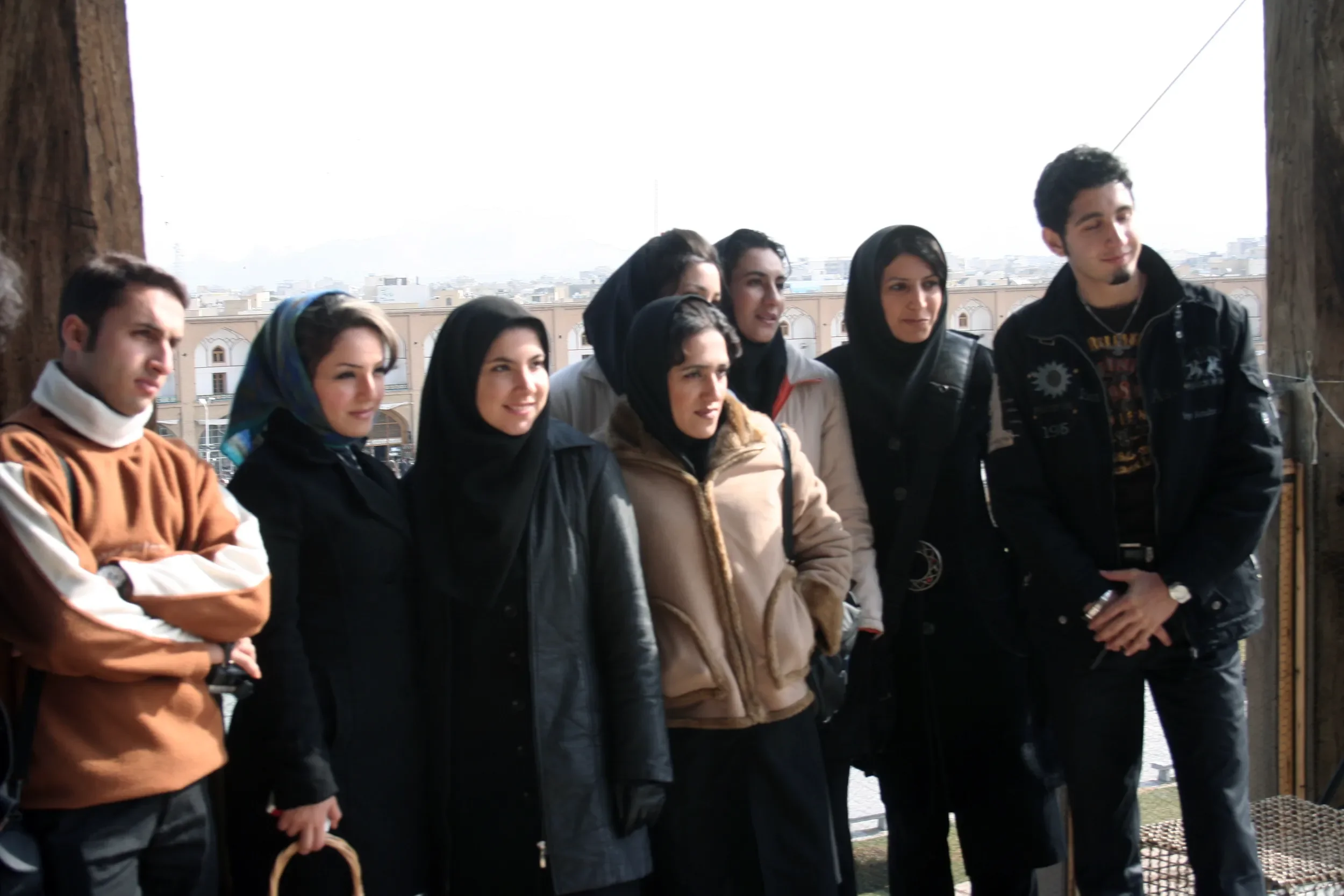
Mennonite trip to Iran, 2008. Photograph courtesy of Doug Hostetter.
First, I want to begin with definitions of the Mennonite Church and the Mennonite Central Committee, commonly referred to as MCC.
The Mennonite Church originated in the Radical Reformation in Switzerland, Germany and the Netherlands in the 16th-century Protestant Reformation. Recognized as a historic peace church, Mennonites practice nonresistance, reject violence, and refuse military participation.
MCC is the relief, development, and peacebuilding organization of the Mennonite churches of the United States and Canada.
The engagement of Mennonites with Iran has developed over a period of more than 35 years. The involvement has included disaster and refugee relief, a student exchange program, interfaith dialogue conferences, participation of Iranians in peace studies at Mennonite universities, learning tours to Iran, and meetings with Presidents of the Islamic Republic of Iran. I speak from my experience as the Director of Central and Southern Asia program of the Mennonite Central Committee (MCC), director of Eastern Mennonite University’s (EMU) Center for Interfaith Engagement (CIE), and founding member of Luke 10 Yahad Co.
Relief and Reconstruction
Mennonite involvement in Iran began following a disastrous earthquake in June of 1990 in the northwest provinces of Gilan and Zanjan. MCC wanted to respond for two reasons. One was the scale of the tragedy—more than 35,000 people had been killed and many more were injured and had their homes destroyed.
However, MCC does not respond to all major disasters, particularly if they are in countries in which MCC does not have a history of involvement. The geopolitical situation of that time was a major factor in the decision to become involved in responding to this tragic earthquake in Iran. This was just after the end of the Cold War with the destruction of the Berlin Wall and the collapse of the Soviet Union. It seemed to some of us that, in the eyes of the government of the United States, political Islam had replaced communism as the enemy and Tehran, instead of Moscow, was seen as the source of evil in the world. It seemed important for MCC to respond to the earthquake in Iran to demonstrate that it would respond to human need wherever it occurred irrespective of the religion and politics of the country. MCC wanted to reach out to the people of Iran and to build bridges of understanding and friendship.
Prior to this earthquake, MCC had no program or contacts in Iran and there were no diplomatic relations between the United States and Iran. MCC did not know how to respond.
The MCC office in Ottawa in Canada contacted the Iranian embassy in Ottawa and informed them of Mennonites’ interest in responding to the earthquake, indicating it would like to contribute to the reconstruction phase of the response to the earthquake and asked if a delegation could travel to Iran to explore how it could contribute to the rebuilding. Some in MCC were skeptical that permission to send a delegation would be given. Then in August, 1990, Iraq invaded Kuwait, and there was a large buildup of American military forces in the region, and it seemed extremely unlikely that a Mennonite delegation would be able to visit Iran. Much to MCC’s surprise, later that fall the MCC Ottawa office reported that the Iranian embassy had replied that MCC could send a delegation, that it could include both Canadians and Americans, and when it wanted to go. MCC decided to send a four-person delegation in early January 1991.
The four-man delegation, including two Canadians and two US citizens, was hosted by the Ministry of Foreign Affairs and the Iranian Red Crescent Society (IRCS). After a visit to the earthquake-affected area and discussions with the IRCS and government agencies, MCC decided to fund the construction of 15 village health clinics, termed Health Houses, in the earthquake-affected area.
During this visit Mennonites learned to know Mr. Sadreddin Sadr, the Director General for International Affairs of the IRCS. Mr. Sadr had a vision of what cooperation between MCC, a North American Christian humanitarian organization, and the IRCS, an Iranian, essentially Islamic humanitarian organization, would symbolize. The IRCS is a very large, extremely capable and experienced relief organization that did not need the modest resources that MCC has given it. In fact, Mr. Sadr essentially told MCC that IRCS did not need MCC’s resources but that they valued the cooperative relationship. He asked MCC personnel to speak to his staff about MCC and the values that motivated its humanitarian service.
MCC cooperated with the IRCS on response to several natural disasters—earthquakes, floods, drought—as well as Iraqi refugee relief following the first Persian Gulf war in 1991. MCC also provided resources to IRCS to assist internally displaced Afghans in camps run by the IRCS inside Afghanistan during the 2002 war with the Taliban.
For the first six years of MCC’s Iran program, the IRCS was its primary partner. It would arrange the visa authorization and would host MCC officials. Through this partnership, MCC staff were able to travel to many areas of Iran to see the work of IRCS and to meet many of its very capable and dedicated staff.
Student Exchange
In 1993, Mr. Sadreddin Sadr spent time in Washington, DC, while his wife, a sociology professor, received a fellowship to spend a year at the Center for Muslim Christian Understanding at Georgetown University in Washington, DC. While in Washington, Mr. Sadr visited the Iranian Mission to the UN in New York. He explained to the ambassador and some of the staff the relationship between the IRCS and MCC. Following that visit, he encouraged MCC to visit the Iranian Mission. MCC program staff made a visit to introduce MCC to the ambassador, Dr. Kamal Kharrazzi, and some of his staff, including Dr. Seyed Kazem Sajjadpour, who was a representative of the Institute of Political and International Studies (IPIS), the research and policymaking department of the Iranian Ministry of Foreign Affairs.
MCC usually does not simply give grants to partners but also sends personnel as service workers to countries in which it is involved, but this did not seem possible in Iran. During the Cold War between the US and Soviet Union, MCC had sent graduate students to study in universities in Eastern European cities as a way to learn to know Eastern European people and culture when the communist countries were considered the enemy of the United States. Based on this experience, MCC thought of proposing a student exchange to enable North American MCCers to live in Iran and Iranian students to study in North American universities.
Both the Ambassador Kharrazzi and Dr. Sajjadpour at the UN were interested in the student exchange idea and encouraged MCC to send them a proposal that they would then take to Tehran. MCC wanted students it would send to Iran to study Farsi, Islam, Persian culture and history and thought that Iran would likely want to send engineering and science students to study in Canada or the US. MCC was pleasantly surprised when informed that Iran wanted to send some top philosophy and theology students to study philosophy of religion.
In April 1997, the MCC Executive Director, Dr. Ron Mathies, and I went to Iran and negotiated an agreement with the Imam Khomeini Education and Research Institute (IKERI) for a student exchange. This worked out well with MCC students studying Farsi and Islam at IKERI in Qom, and Iranian students studying philosophy of religion at the Toronto School of Theology. IKERI is an extremely conservative institution, both politically and religiously. Despite its conservative orientation, the institute was willing to host North American Mennonite Christians and to send some of its best students to study in Canada.
Under the agreement for the exchange signed between IKERI and MCC in 1997, four Mennonite couples studied in Qom, and two Iranian families were in Toronto while the husbands completed Ph. D. degrees in philosophy of religion. Both the Iranian and Mennonite students had opportunities to speak in various settings about their faith and their country. Through this, North American Mennonites and Iranian Muslims learned to know each other as neighbors and studied each other’s religion, an important aspect of each one’s life.
Christian-Muslim Dialogue
In addition, there have been eight interfaith dialogue conferences involving North American Mennonite scholars and Iranian Islamic scholars—four in Canada and four in Qom. The first one was in Toronto in October 2002, and the last one in Qom in June 2023. The purpose has been to build on the relationships developed through the student exchange and to enable the professors to learn to know each other better and to engage in dialogue on issues of common interest.
An expert in interfaith dialogue, Dr. M. Darrol Bryant, noted the depth of dialogue and friendship between the North American Mennonite scholars and the Iranian Muslim scholars and attributed it to the fact that there was a relationship between them that had developed over considerable time.
It should be mentioned that there has been strong criticism of the Mennonites for engaging in dialogue with conservative Iranian Muslims. (Tourage, Mahdi, 2009), and the first session of Dialogue III at the University of Waterloo in Ontario was shut down by demonstrators protesting against this dialogue. The Mennonite position has been that it is important to dialogue with anyone, including those with whom one may not agree. And at a time when the governments of Iran and the US do not have diplomatic relations and very little contact, it is important to engage Iranians.
Collaboration between Canadian Mennonite University (CMU) and International Institute for Islamic Studies (IIIS)
CMU in Winnipeg and IIIS in Qom have had a relationship for more than ten years that has been formalized in a Memorandum of Understanding (MOU). Under this agreement, there have been exchanges of students and, more importantly, teaching stints by professors from CMU at IIIS in the area of Peace and Conflict Resolution Studies. For a number of years, including the current term, there have been professors from CMU teaching one of these courses. Faculty of CMU very much appreciate the interaction with both the professors and students of IIIS.
Additional Exchanges
Learning tours of North American Mennonites and others from the US and Canada have been hosted by IKERI and other institutions in Iran. These have enabled Canadians and Americans to visit Iran—very few North Americans have this opportunity—to meet ordinary Iranians and experience their generous hospitality, to attend lectures on Islam and Iran, to visit historical sites, and observe the rich Iranian culture. I find that Americans who have an opportunity to visit Iran come back with a completely different understanding and attitude toward the people of Iran.
The Center for Interfaith Engagement at Eastern Mennonite University hosted a couple of visiting Iranian Islamic scholars for three years. They taught courses such as Introduction to Islam; Issues in Islam; Islamic Spirituality; Women in Islam; Elementary Farsi; and Women, Religion, and Politics in Iran. They were also wonderful resources on Islam and Iran on campus and in the local community.
EMU’s Center for Justice and Peacebuilding has hosted at least twenty Iranian participants in its Summer Peacebuilding Institute where peace practitioners and scholars from many countries spend six weeks in classes and intense interaction. Three of these Iranian participants returned to complete the master’s degree in Conflict Transformation and Peacebuilding at EMU.
Meetings with Presidents of Islamic Republic of Iran
In 2006, in a phone call with Mr. Ali Akbar Rezai, an official in the Foreign Ministry and the first Iranian participant in the Summer Peacebuilding Institute at EMU, I received a surprising request. He said that the president would be visiting the US. I thought that he was referring to former President Khatami, because I was aware that he was coming to the US. But no, he was referring to the current President Ahmadinejad. He asked me if I could arrange a meeting for him with US religious leaders. He said that he had had such a good time relating to American religious leaders when he attended SPI and that he would like the president to have that experience. I did not know if that would be possible, but I said that I would try.
In September of 2006, it was possible to arrange a meeting for President Ahmadinejad with about 45 American religious leaders. He invited a smaller delegation of American religious leaders to visit Iran in the winter of 2007 when, as he said, “The nights are long, and we can stay up late talking about religion.” A group of 17 Americans, representing different Christian denominations visited in February 2007. And in September of the following two years, there were meetings of American and Canadian religious leaders with President Ahmadinejad when he was attending the UN General Assembly. Other Mennonites and I have also participated in meetings of religious leaders with Presidents Raisi and Pezeshkian when they have been at the UN General Assembly.
Luke 10 Yahad Co., the final involvement
At the time of the COVID pandemic, Rev. Doug Hostetter--a Mennonite peace activist—and I, along with two others with contacts to Iran, formed Luke 10 Yahad Co. to provide some assistance to Iran. We decided to do this because the situation was bad in Iran and the US sanctions against Iran made it more difficult for the government of Iran to respond to this crisis. We chose the name Luke 10 because Luke 10 is the chapter in the New Testament of the Bible where an expert in the law asked Jesus what he must do to inherit eternal life. The answer was that he must love God with all his strength and all his mind, and “Love your neighbor as yourself.” We consider the people of Iran our neighbors to whom we must show love.
Luke 10 was able to raise $100,000, which was transferred to Moms Against Poverty, an American NGO that has a US government OFAC (Office of Foreign Assets Control) license permitting it to provide humanitarian assistance to Iran. Since then, Luke 10 has organized ten interfaith webinars involving Islamic scholars and leaders from Iran and Christian and Jewish scholars and leaders from North America.
Luke 10, along with religious leaders in Iran, drafted two statements that were sent to the governments of the Islamic Republic of Iran and the United States. One entitled “A Time for Peace” was delivered to both governments just before the bombing was started by the governments of the US and Israel, with the hope of preventing a war. The other, “Choose Diplomacy, Not War,” was delivered on September 24th to encourage an end to the war. Both statements were signed by Muslim leaders in Iran and Christian, Jewish and Muslim leaders in the US.
Keys to Authentic Engagement
As I have reflected on the experience of Mennonite engagement with Iran, I have come up with several key principles that I think have made this involvement possible.
Transparency - From the very first visit to Iran, Mennonites made it very clear that they represented a church-related agency whose humanitarian service was motivated by their religious faith and the teachings of Jesus. MCC personnel had to be ready to discuss their faith in many different settings, including with ambassadors, officials in the foreign ministry, many religious leaders, and scholars.
Respect - It was very important to treat people with respect, to adjust schedules and menus according to their needs.
Patience and Persistence - Developing a program and long-term relationships across the political and religious divides evident between the United States and Iran requires an attitude of patience and persistence. Developing relationships of trust takes time and multiple encounters. On a practical matter, visas were often approved only at the very last minute, and many people would have given up. Mennonites worked very closely with the hosting agency and the Foreign Ministry to try to get visas approved. Several times travel had to be rerouted to collect a passport from the Iranian embassy in Ottawa or the Interests Section in Washington because there was not enough time for it to be mailed back to the traveler.
Openness to the leading of God’s Spirit (Vision) - The Iran involvement did not develop in response to a well-developed, long-term strategic plan. It developed with a vision—to promote relationships between Iranians and North Americans—and then responded to various opportunities that opened up under the leading of the Spirit.
References
Bryant, M. Darrol, Susan Kennel Harrison, and A. James Reimer (eds.). 2010. On Spirituality: Essays from the third Shi’i Muslim Mennonite Christian Dialogue. Kitchener, Ontario: Pandora Press.
Huebner, Harry J. and Hajj Muhammad Legenhausen (eds.). 2011. Peace and Justice: Essays from the Fourth Shi’I Muslim Mennonite Christian Dialogue. Winnipeg, Manitoba: CMU Press.
Huebner, Harry J. and Hajj Muhammad Legenhausen (eds.). 2012. On Being Human: Essays from the Fifth Shi’i Muslim Mennonite Christian Dialogue. Winnipeg, Manitoba: CMU Press.
Reimer, A. James. 2003. “The Challenge of Modernity: Shi’ah Muslim – Mennonite Christian Dialogue.” The Conrad Grebel Review, Volume 21, Number 3, Fall 2003. Waterloo, Ontario: Conrad Grebel University College.
Reimer, A. James. 2006. “Revelation and Authority: Shi’ah Muslim – Mennonite Christian Dialogue II.” The Conrad Grebel Review, Volume 24, Number 1, Winter 2006. Waterloo, Ontario: Conrad Grebel University College.
Tourage, Mahdi. 2009. “Fetishizing Dialogue and Commodifying Peacemaking.” American Journal of Islamic Social Sciences 26.1
