
By Peter M. Sensenig, PhD, Near East School of Theology, Beirut
University of Tehran, 7th International Conference on Peace and Conflict Resolution
October 26-27, 2026
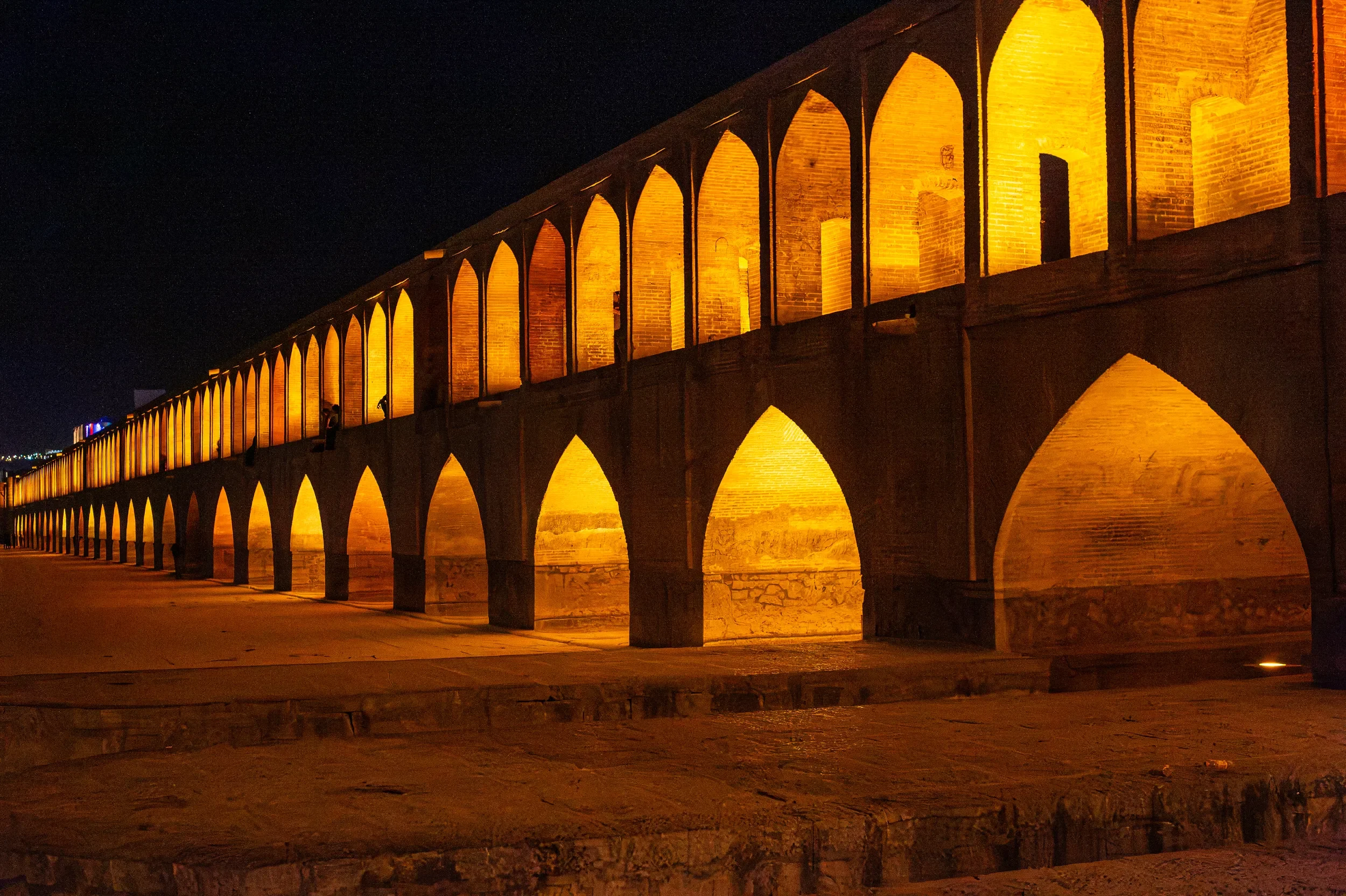
Si-o-se-pol Bridge, Isfahan, Iran. Photo: Andrea Tabaro / iStock.
What do we believe about the future of our world? In other words, what is our eschatology? This is an important question for believers of all kinds, including Shi’a Muslims and Protestant Christians. My own tradition, Anabaptist Christians, had at its origins some who wanted to build the kingdom of God by force. Others wanted a more spiritual vision of the future, what we might call a quiet eschatology.¹
I want to argue that eschatology is not first of all theology. It is primarily ethical. What I mean is that eschatological belief is a powerful driver of our interactions with one another. We cannot separate our vision of the future from our relationships of the present.
When we see eschatology practically and not just theologically, there are some major challenges to peace. In some circles Christian Zionism has a tremendous influence on the church. Christian Zionism causes some Christians to put people of other faiths into the category of not just their own enemies, but God’s enemies. My Palestinian and Lebanese theology students in Beirut are deeply hurt by this theology, and its implications for their communities and their identity.
I would venture to guess that certain Islamic eschatologies can have the same effect, of equating our enemies with God’s enemies.
This is the toxic eschatology that we are up against. Given how badly it can damage our relationships, we might want to throw out the whole affair. It can be tempting to assume that convictions about the future, in the context of inter-religious conflict, should be avoided if peace is to be pursued.
But I want to argue here that, on the contrary, eschatology can and should be a motivator for peace. I will describe what makes an eschatology weak or strong, as it relates to building peace.
I. The moral imagination as essential to peacebuilding
A goal-oriented theology is a crucial asset for peacebuilding. Another way to think about this is what John Paul Lederach calls the moral imagination. Moral imagination is the capacity to connect the real world we live in to a future we hope to bring about.² Social change is by nature an act of imagination. Peacebuilding requires the ability to imagine a web of relationships with our rivals included.³
As people of faith we know that we are not the primary actors in history. God the creator and sustainer of the universe is the only one capable of envisioning and guiding us toward peace. Let us not imagine that we are on our own.
But neither let us make the mistake in the opposite direction, of understating our role in God’s purposes. In the Christian tradition, that we as humans are created in the image of God means that we are given tremendous power as God’s representatives on earth.⁴ In Islamic theology the human status of khalifah (خليفة), stewards of creation, is a similar notion.⁵ We are entrusted by God with not just our environment, but with our relationships with one another. We might go so far as to say that God has made us partners—not in nature or equality with him—but gifted and equipped for this particular task of peacebuilding. Jesus (PBUH) said to his disciples, “I now call you friends, because I have revealed God’s plan to you, which is that you love one another” (John 15:15, 17). He was conferring on his disciples the permission to act with authority. He was giving them the freedom and the power to use their moral imagination.
One of the divine gifts for moral imagination is what Islamic theology calls fikr (فِكْر). Fikr is active thought, deep reflection, and critical reasoning. God has given us the necessary tools for discerning the path of peace.⁶
In other words, God has given us the ability to take notice of the web of relationships that we are a part of. This includes the necessary act of confessing our own personal and collective responsibility for the breakdown in peace. And it includes the eyes to see how interdependent we are upon one another. In the words of Lederach, “Peacebuilding requires a vision of relationship. Stated bluntly, if there is no capacity to imagine the canvas of mutual relationships and situate oneself as part of that historic and ever-evolving web, peacebuilding collapses.”⁷
This requires a respect for complexity. It means being curious beyond the clear-cut categories that our governments and our religious institutions try to force on us; categories of who is right and who is wrong, simplistic readings of history, and even the label of enemy. Reflecting on Jesus’ call to love our enemies, Civil Rights leader and pastor Howard Thurman wrote, “Love of the enemy means that a fundamental attack must first be made on the enemy status.”⁸ Moral imagination breaks us free from forced dualism.
As God’s representatives on earth (image-bearers, stewards), our creativity in building peace is where the divine meets the human. But it demands a willingness to take risks. Moral imagination is risky because violent conflict is what we know, and peace is a mystery. But the fact that God has entrusted us with this earth means that the future is not the slave of the past.⁹ Do we have the courage and will to create a better future?
II. What makes an eschatology weak or strong?
So the first point is that we are not passive recipients of our eschatology. God is not finished with humanity, but continues to create us and to create with us. This brings us to the question: What vision of the future of the world will guide our actions? Will our eschatology be weak (that is, underdeveloped, binary, simplistic thinking)—or strong?
To express what I mean by strong eschatology, let me quote the philosopher Michael Walzer’s description of the messianic age: “a time when these arguments [are] especially intense, wonderfully eloquent, and never bloody.”¹⁰ Honest engagement with the religious other is the quintessential sign of the strength of any religious community. The task of transmitting our faith to our children consists not just of teaching them universal principles, but of training them to deliberate and do the work of justice well. It means developing in ourselves and in our children the skills of contestation in a religiously diverse world.
A. What is a weak eschatology?
By contrast, a weak eschatology is one that has not wrestled with religious diversity. It has not developed the muscles of dialogue and engagement. We can identify three characteristics of a weak eschatology:
1) First, it can only imagine a future with one religious identity left standing. In this way of thinking, history becomes a battleground for control and hegemony. In its worst forms, dominance over the other is treated as proof of divine favor, rather than a betrayal of the divinely appointed tasks of fikr and of building peace.
2) A weak eschatology appeals to economic, political, or military strength to prove its superiority. This is sometimes described as might makes right. But might neither makes right nor proves rightness. Perhaps a distinctive charism of both the Shi’a community and the Anabaptist Christian community to which I belong is the conviction that suffering injustice is not a sign of moral failure. On the contrary, suffering can be the price of faithfulness to God.
War is the ultimate sign of a weak eschatology. Both our traditions have messianic hopes for redemption, ushered in by the Mahdi, and by Jesus Christ. We betray our trust in this promised redemption when we prepare for and commit violence. We also demonstrate our lack of trust that our faith will stand up to the diversity of perspectives of our world.
3) Finally, a weak eschatology communicates to our children that homogeneous societies are preferable. This assumes that the way to defend one’s faith is to limit exposure to other religions, to create the impression that my faith is the norm, and that everything else is abnormal. The problem with this idea is that faith that has never been tested or challenged is not real faith. If we want our children to follow our faith, which I think we all do, then we must develop a stronger eschatology. We must give them the skills of loving contestation with the religious other.
B. What is a strong eschatology?
What then is a strong eschatology that reflects Walzer’s image of the messianic age of intense, eloquent, nonviolent contestation?
1) Interdependence: The first sign of a strong eschatology is that it makes space for the religious other, recognizing that a diverse world is the one that our children will inhabit.
I serve on the board of an organization called the Luke 10 Foundation. In February of this year, as the rhetoric of war was intensifying, we issued a statement as a group of religious leaders from the United States and Iran. We called it “A Time for Peace.” The statement amassed nearly 600 signatures, roughly half from the US and half from Iran.
The statement closes, “We pray that a concerted effort [for genuine peace and cooperation], across national and communal borders, will bear fruit, so that our children and grandchildren can share an increasingly interdependent world in which all inhabitants flourish in lasting peace and security.”¹¹ An interdependent world—this is a strong eschatology that does not have homogeneity as a goal, but rather mutuality in difference.
2) Hope: Needless to say, our statement failed to stop the war. But one thing it did was to reinforce what we already knew—that the personal contacts that each of us had across the Iran-US divide were not limited to a small number of peacemakers. There is widespread good will on both sides.
The second quality of a strong eschatology is hope. Weak eschatology is driven by cynicism. Hope insists on the endurance of human dignity, the divinely invested quality in each of us that seeks genuine relationship. Not hope in our institutions, particularly the ones that are bent on selfishness and destruction. But rather hope that under the layers of hostility, our shared humanity will have the last word, guided by God’s insistent stirring in our hearts toward peace.
3) Trust in the midst of rivalry: This does not mean that we are seeking a kind of uniformity. On the contrary, a strong eschatology is actually better at getting to the heart of differences, because it does not shy away from them. It develops the skills of friendly rivalry and argumentation.
In spite of our best efforts at Luke 10, we did not stop the war. But we refuse to give up on peace. Last month we released another statement, this one entitled “Choose Diplomacy, Not War.” This statement speaks of trust. It reads, “Our interpersonal ties across borders demonstrate that building trustworthy relationships, based on shared values, is worth the investment of time, concern, and commitment.”¹²
Trust implies difference, and even requires it. The moral psychologist Annette Baier argued that a distinguishing mark of trust is that trust accepts vulnerability, putting oneself in the other’s power.¹³ This is perhaps the aspect of a strong eschatology that is most difficult to accept; we are willing to seek peace until we realize what it might require of us. But faith, submission to God’s will, is inherently vulnerable. The trust we place in God flows into the trust we put into the quest for peace.
III. Conclusion
The separation between the academy and the ordinary believer is one that must be bridged. The solution to violent or divisive eschatologies, however, is not debunking them directly, but rather offering a positive alternative grounded in Scripture. What a strong eschatological reading of the Qur’an and the Bible might look like is beyond the scope of this paper. But it is a conversation that we should have. Both Muslim and Christian communities can exercise the type of moral imagination that makes space for the other.
Notes
1. Andrew Dylan Klassen Brown, “Peace in the End Times: Apocalyptic Expectation and Sixteenth Century Anabaptist Peace Theology.” Master’s thesis, Canadian Mennonite University, 2021.
2. John Paul Lederach, The Moral Imagination: The Art and Soul of Building Peace (New York: Oxford University Press, 2005), ix.
3. Ibid., 5.
4. William Sanford Lasor, David Allan Hubbard, and Frederic William Bush, Old Testament Survey: The Message, Form, and Background of the Old Testament, 2nd ed. (William B. Eerdmans Publishing Co.: Grand Rapids, MI, 1996), 24.
5. Avif Alfiyah, Sri Yuliawati, and Firda Utami, “Humans as Caliphs on Earth Environmental Responsibility in Islamic Perspective.” Jurnal Kajian Islam 1(2) (August 2024), 1. Available at https://doi.org/10.56566/jks.v1i2.243
6. Mohammed Abu-Nimer, “A Framework for Nonviolence and Peacebuilding in Islam,” Journal of Law and Religion, vol. 15 (2001), 220. Abu-Nimer adds Islamic peacebuilding values of justice (adl), beneficence (ihsan), and wisdom (hikmah).
7. Lederach, Moral Imagination, 35.
8. Howard Thurman, Jesus and the Disinherited (Richmond, Indiana: Friends United Press, 1981), 97.
9. Lederach, Moral Imagination, 36-40.
10. Michael Walzer, “A Particularism of My Own,” Religious Studies Review, vol. 16, no. 3 (July 1990), 196.
11. “A Time for Peace,” Statement of Luke 10 Foundation, February 2026. Available at https://luke10.faith/a-time-for-peace.
12. “Choose Diplomacy, Not War,” Statement of Luke 10 Foundation, September 2026. Available at https://luke10.faith/choose-diplomacy-not-war.
13. Maria Baghramian, Danielle Petherbridge, and Rowland Stout, “Vulnerability and Trust: An Introduction,” in International Journal of Philosophical Studies, vol. 28, no. 5 (2020), 575. Available at https://doi.org/10.1080/09672559.2020.1855814.
Works Cited
Abu-Nimer, Mohammed. “A Framework for Nonviolence and Peacebuilding in Islam.” Journal of Law and Religion, vol. 15 (2001): 217 – 265.
Alfiyah, Avif, Sri Yuliawati, and Firda Utami. “Humans as Caliphs on Earth Environmental Responsibility in Islamic Perspective.” Jurnal Kajian Islam 1(2) (August 2024):1-6. Available at https://doi.org/10.56566/jks.v1i2.243.
Baghramian, Maria, Danielle Petherbridge, and Rowland Stout. “Vulnerability and Trust: An Introduction.” International Journal of Philosophical Studies, vol. 28, no. 5 (2020): 575–582. Available at https://doi.org/10.1080/09672559.2020.1855814
Brown, Andrew Dylan Klassen. “Peace in the End Times: Apocalyptic Expectation and Sixteenth Century Anabaptist Peace Theology.” Master’s thesis, Canadian Mennonite University, 2021.
“Choose Diplomacy, Not War.” Statement of Luke 10 Foundation, September 2026. Available at https://luke10.faith/choose-diplomacy-not-war.
Lederach, John Paul. The Moral Imagination: The Art and Soul of Building Peace. New York: Oxford University Press, 2005.
Lasor, William Sanford, David Allan Hubbard, and Frederic William Bush. Old Testament Survey: The Message, Form, and Background of the Old Testament. 2nd ed. William B. Eerdmans Publishing Co.: Grand Rapids, MI, 1996.
Thurman, Howard. Jesus and the Disinherited. Richmond, Indiana: Friends United Press, 1981.
“A Time for Peace.” Statement of Luke 10 Foundation, February 2026. Available at https://luke10.faith/a-time-for-peace.
Walzer, Michael. “A Particularism of My Own.” Religious Studies Review, vol. 16, no. 3 (July 1990): 193-197.
